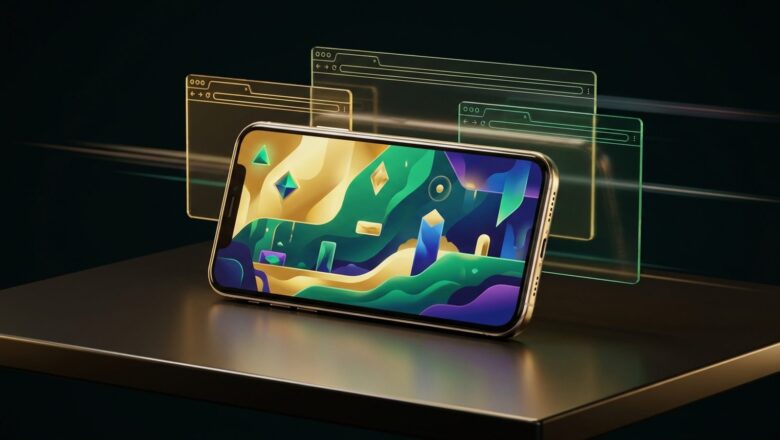
Ten years ago, a serious game meant an install: a console disc, a PC download, an app from a store. Today a large share of casual games open in a browser tab, on a phone, in a second. Nobody downloads anything, nobody updates anything, and the game still looks and moves like an app. That shift did not come from one breakthrough. It came from a handful of technical changes that are easy to overlook, and that are worth understanding if you build anything for the web.
The browser became a graphics engine
For a long time, the only way to draw complex moving graphics in a web page was a plug-in. HTML5 changed that with the canvas element, a drawing surface built into every browser. WebGL then gave web pages direct access to the graphics chip of the device, the same chip native games use. A browser can now draw thousands of moving images per second, with transparency, blending and effects, without any plug-in.
On a phone, this matters even more than on a desktop. Mobile graphics chips are efficient, but only if the work is sent to them in the right way. WebGL lets developers do exactly that.
JavaScript got fast enough
The second change happened inside the browser’s JavaScript engine. Modern engines compile code while it runs and optimise the parts that are used most. Game logic that would have stuttered a decade ago now runs smoothly, even on mid-range phones. Memory management improved too, which removes the small freezes that used to break the feeling of a smooth game.
Libraries took over the hard parts
Few teams write WebGL code by hand. Rendering libraries such as PixiJS handle the heavy lifting: grouping images so the graphics chip draws them in one pass, managing textures, keeping a steady frame rate across devices. Developers can focus on the game itself instead of on the plumbing.
Tooling followed. Texture packers combine dozens of images into a single sheet. Build tools compress assets and load them in the right order. A modern browser game can show its first screen in a couple of seconds and load the rest while the player is already looking at it.
Animation got lighter
The last piece is animation. Early web games used frame-by-frame animation: one image per frame, hundreds of images per character. That is heavy to download and heavy to keep in memory.
Many games now use skeletal animation instead. An artist draws a character in separate parts: head, arms, eyes, clothing. An animator builds a skeleton for it in a tool such as Spine and animates the bones. The game then plays the motion in real time from a small data file. One set of images can produce many different animations, at any screen size, with very little memory.
Where you can see all of this at once
Online slot games are a good example of every one of these changes working together. They run in the browser, mostly on phones held upright, often in short sessions. Every symbol, character and win is animated, and the game has to stay smooth for hundreds of spins in a row without heating the phone or draining its memory.
That is why slot studios lean heavily on skeletal animation. Studios such as MakeYourSlot animate slot symbols and characters in Spine for exactly this reason: rich motion that still loads fast and runs smoothly on a phone.
What it means for the web
The browser did not replace consoles or high-end PC games. But for short, frequent play sessions, it has quietly become the default platform. The same techniques are now used outside games too: interactive product pages, animated onboarding screens, data visualisations. If something on a web page moves smoothly on your phone today, there is a good chance it uses the tools games made popular.
Related Articles

For years, choosing a web host meant comparing storage quotas and monthly prices. In 2026, the conversation has changed. Data sovereignty, GDPR compliance, page speed...

Illustration — contexte terrain (génération éditoriale gpt-image-2). Entre les usages éditoriaux de tooloratech.com et les besoins terrain d’une PME francilienne, le même fil revient...

Louer une voiture avec chauffeur pour plusieurs semaines ou plusieurs mois était jusqu’ici associé aux flottes de luxe ou aux contrats d’expatriés. Mais une tendance...