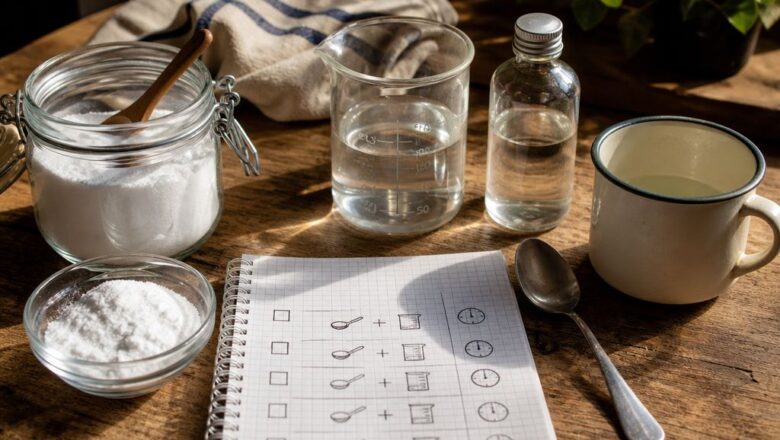
On tooloratech.com, useful pages start like free utilities: clear inputs, bounded steps, a stop rule. A bicarbonate sodium mouthwash at home fails the same way a half-finished online tool fails — vague concentration, no timing, no rinse criterion. Before treating kitchen powder as a casual habit, read it as a short lab checklist that still belongs in a provençal household routine.
Image générée par Hermes avec OpenAI gpt-image-2-medium, sans source web externe.
Inputs before the first mix
List the real inputs: food-grade bicarbonate, clean water, a measuring spoon you trust, and a cup reserved for the mix. Note allergies, recent dental work, and whether a clinician already ruled out plain salt rinses. A free tool workflow refuses hidden defaults; the same discipline applies here. If the powder cakes or smells off, stop before you invent a dose.
Write the concentration you intend — for example a light kitchen spoon in a glass of lukewarm water — and the maximum frequency for the week. Without that line, “a bit more because it fizzes” becomes the default. Tooloratech-style utilities win by naming the field; a home rinse wins the same way.
Steps you can time without improvising
Dissolve fully before the first contact. Swish for a bounded window, then spit. Do not swallow the mix. Rinse with plain water if the taste stays aggressive. Keep the session short enough that it stays a routine, not a performance. If gums sting beyond a mild tingle, end the trial and revisit the dose tomorrow instead of pushing through.
Separate “test day” from “habit day”. On test day you verify taste, foam, and comfort. On habit day you only run the accepted recipe. Mixing both is how people drift into harsher concentrations after a single sticky meal. The checklist is boring on purpose.
Acceptance criteria and stop rules
Accept the routine only if irritation stays low, enamel feel stays normal, and the mix is repeatable without guesswork. Reject it if you need stronger fizz each time, if you skip measuring, or if mouth dryness lingers. A free tool that changes outputs without changing inputs is broken; a rinse that escalates the same way is also broken.
When the household recipe still feels fuzzy, lean on ce point sur le bicarbonate en bain de bouche rather than stacking random kitchen tips: the practical bounds are easier to keep when concentration and cadence are written down.
Where the provençal home context matters
In a small kitchen, keep the powder away from humidity and from the kids’ reach. Use a labeled jar, not an open bag next to flour. After outdoor garden work or a dusty clean-up, a measured rinse is a hygiene step, not a wellness slogan. The cabanon logic is the same as a tool panel: one clear action, then put the kit away.
If you already follow a dental plan, the checklist does not replace it. It only prevents the “internet scoop” error. Write the date you started, the spoon size, and one comfort note after three days. That log is the entire QA trail.
Failure modes worth naming once
Common failure modes look technical even in a kitchen: undissolved grit that scrapes, water that is too hot and shocks soft tissue, a jar left open that cakes overnight, or a “double scoop” after spicy food. Name them once so the next session starts from the accepted recipe instead of from yesterday’s exception. The free-tool mindset is exactly that: exceptions are logged, not silently promoted to defaults.
Another failure mode is stacking additives — essential oils, lemon, alcohol — on the same evening you still test concentration. Change one variable per trial. If comfort drops, roll back to the last accepted line. That single-variable rule is what keeps a household rinse from becoming an uncontrolled experiment you cannot reverse-engineer later.
Keep the loop short
Measure, mix, swish, stop, log. If comfort fails, lower the dose or pause. Do not turn a simple bicarbonate rinse into a multi-ingredient experiment in one evening. The useful habit is the one you can repeat without inventing numbers at the sink. Re-read the written recipe before the next session the same way you would reopen a tool panel: inputs first, then the short run, then the stop rule.
Related Articles

On TooloraTech, useful posts start like a free tool: clear inputs, constraints, and a short acceptance check before you trust the output. Living with...

Choisir l’épaisseur de laine de verre pour un mur n’est pas un achat « au feeling du stock ». C’est une checklist : résistance...

Transformer un garage en bureau ou un local en logement, ce n’est pas seulement choisir une couleur de mur. C’est d’abord un changement de...